24Aug 22
- Admin Web Papua
- Ekonomi Daerah
- 5568 x dilihat.

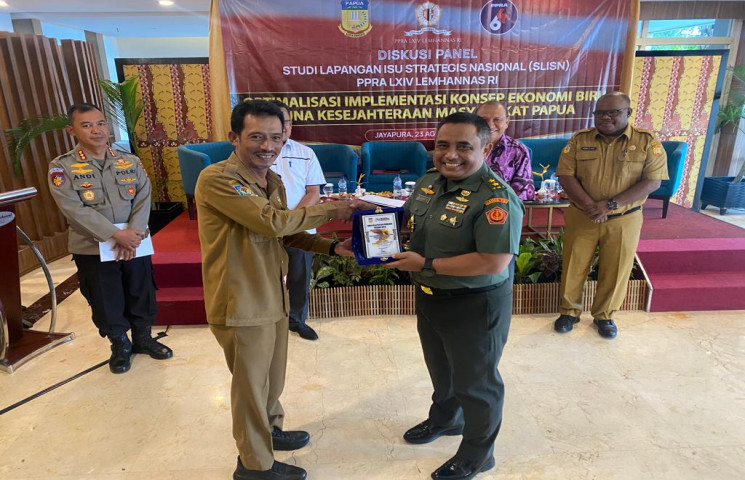
JAYAPURA - Participants of the Regular Education Program (PPRA) Batch-64, Lemhannas of Republic of Indonesia are certain to immediately make a study on the concept of the blue economy related to the development of the Papuan fisheries world and the improvement of national resilience in related fields.
This was said by the Deputy of Education of the National Level Leader of the Indonesian National Institute of Defense, Sugeng Santoso to the press, after participating in a panel discussion with the topic of Optimizing the Implementation of the Blue Economy Concept for the Welfare of the Papuan People, at one of the hotels in Jayapura City, Tuesday (23/8/2022).
He said he received a lot of input from the discussion, so his party encouraged that the concept of a blue economy in Papua, must be further improved in a better direction in the future.
"Moreover, this panel discussion activity was attended by various speakers ranging from academics, practitioners, government and elements of the National Armed Forces and Police" said Sugeng.
He ensured that all existing inputs were immediately studied, analyzed and processed so that the results were immediately reported to the leadership of the Lemhanas to be forwarded to the central government.
Because one of the functions of the Lemhannas is to make studies submitted to the government to make policies to increase national resilience".
"But indeed inputs related to the blue economy concept that emerged in this panel discussion seemed to need support from relevant stakeholders or the central government in optimizing the use of large marine natural wealth in Papua".
"For example, human resource development, direct budget support in Jayapura for industries in the fisheries sector. So it is hoped that the fish can be managed and even directly exported from Papua," he said.
Head of the Marine and Fisheries Department of Papua Province, Iman Djuniawal, said that the blue economy concept actually has the potential to have a positive impact. Especially in the use of aquatic ecosystems that remain sustainable.
It's just that, Iman added, its implementation requires huge budgetary support. Moreover, the water area of Papua has a very large area, the geographical and topographical conditions are quite difficult.
"Of course, budget support is needed in addition to the cooperation of the community and all related parties," he concluded. ***


