24Oct 25
- Admin Web Papua
- Ekonomi Daerah
- 3488 x dilihat.

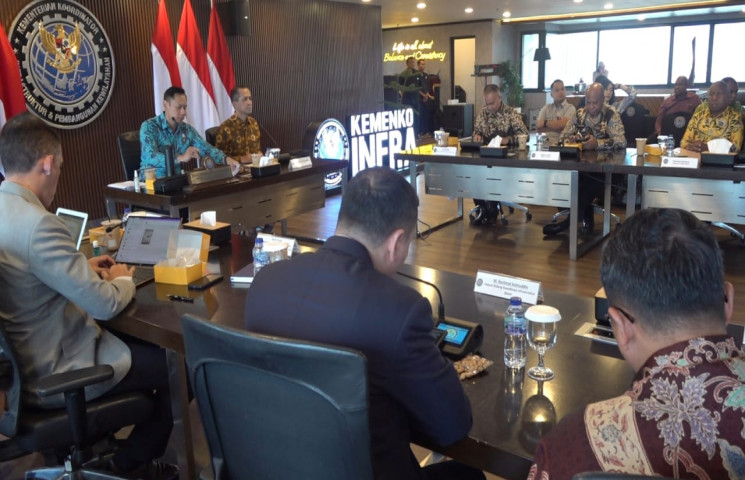
JAKARTA – Papua Governor Matius Fakhiri emphasized that accelerating development in Papua must begin with strengthening inter-regional connectivity.
He made this statement after attending a meeting with Coordinating Minister for Infrastructure and Regional Development Agus Harimurti Yudhoyono and the five governors of Papua’s new autonomous regions. The meeting was held at the Coordinating Ministry for Infrastructure Office in Central Jakarta on Thursday (October 23, 2025).
The discussion focused on the central government’s strategic agenda to accelerate Papua’s development — including opening new economic zones, improving land, sea, and air transportation access, and prioritizing the completion of the Trans-Papua Road as a key effort to strengthen connectivity in eastern Indonesia.
“Papua’s development cannot be separated from efforts to strengthen connectivity. For example, the Trans Jayapura–Wamena Road must be fully functional and of high quality. Once this route operates optimally, agricultural products from Keerom and Jayapura Regency can reach Wamena in just one day,” Fakhiri said.
Governor Fakhiri believes that improved connectivity will catalyse the growth of new economic centers across Papua.
According to him, when land, sea, and air transport routes are well integrated, logistics distribution becomes faster, costs decrease, and community welfare significantly improves.
“We want equitable growth across Papua. Development should not only benefit coastal and urban areas — the highlands must also gain access and enjoy affordable prices for necessities,” he emphasized.
He further explained that one of the future development focuses is to open a land route connecting Wamena–Puncak–Puncak Jaya–Intan Jaya to Central Papua, which is expected to create new economic hubs along the route.
In addition to road infrastructure, the Papua Provincial Government is also working to strengthen interregional maritime and logistics fleets, particularly for northern coastal areas such as Sarmi, Yapen, and Waropen.
“Papua needs an adequate maritime fleet to ensure that the mobility of goods and services between regencies runs quickly and efficiently,” he added.
Fakhiri welcomed the central government’s commitment — through the Coordinating Ministry for Infrastructure and other relevant ministries — to accelerating development in Papua.
He noted that the leadership of Minister Agus Harimurti Yudhoyono brings renewed enthusiasm for building a sustainable and equitable Papua.
“We appreciate Minister AHY’s swift action to ensure that Papua receives serious attention. The central and regional governments must work hand in hand to make sure development is not partial, but integrated,” he said.
Furthermore, he emphasized that cross-sector synergy is crucial to ensure that the outcomes of development are genuinely felt by the people, particularly those in remote and underdeveloped areas.
Fakhiri also reiterated that Papua’s development must be oriented toward welfare and social justice.
He expressed hope that all development programs would not only focus on physical infrastructure but also on improving the quality of human resources among Indigenous Papuans.
“Papua has tremendous potential — both in its natural and human resources. Our duty is to ensure that development is fair and inclusive for all layers of society. When people prosper, Papua will remain peaceful,” concluded Governor Fakhiri. ***


