21Jun 24
- Admin Web Papua
- Kesehatan
- 5684 x dilihat.

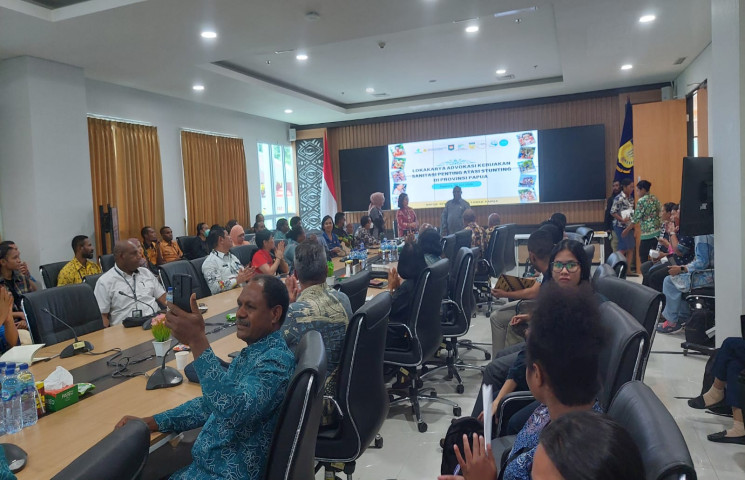
JAYAPURA - Papua Governor Muhammad Ridwan Rumasukun encouraged seven districts in his region to achieve the target of 100 percent of villages immediately and sub-districts to stop or be free of open defecation (BAB) this year.
"The behavior of open defecation cannot be underestimated. Careless defecation commonly abbreviated as careless bowel movements is a serious problem that has a detrimental impact on the environment, and has the potential to transmit disease germs such as diarrhea, typhoid, dysentery or cholera."
"Even children who often experience these diseases, of course, their growth is not optimal and cause stunting and even death," said Ridwan Rumasukun in a written speech read by the Governor's Expert Staff for Community Affairs and Human Resources of Papua, Daniel R Senis, at an Advocacy Workshop on Important Sanitation Policies to Overcome Stunting, in Jayapura City, Thursday (20/6/2024).
According to Ridwan, Open Defecation-Free has reached 100 percent in Biak Numfor Regency and Jayapura City. He encouraged the two regions to immediately realize safe sanitation, under the mandate of the sustainable development goals
"So, I would like to express my deepest appreciation to all parties who attend this meeting."
"Hopefully, the workshop will have a positive effect to immediately encourage the achievement of Papua Province as the first province to stop open defecation in the Land of Papua," he hoped.
UNICEF Papua Representative Head, Aminuddin Ramdan, explained to reporters the importance of good sanitation in villages and sub-districts to overcome stunting. Sanitation also has a lot to do with other disease issues such as polio, which is transmitted through human feces.
Meanwhile, according to data collected by his institution, 500 villages in Papua are still not free from open defecation. This means that the practice of defecation in various regions still occurs massively, which has the potential to transmit diseases.
"That's why through this workshop we hope that there will be a follow-up from the Papua Provincial Government to encourage the circular letter as well as accelerate the regents so that the villages are given latrine facilities (for those who do not have them)."
"Then for those who already have it but still practice defecation carelessly, we continue to socialize them to change their behavior," hoped Ramdan.
On that occasion, he hoped for the role of traditional leaders, community leaders and even religious leaders, to help socialize changes in people's behavior so that they would not defecate carelessly.
"Like religious leaders, for example, in their sermons at church, they may persuade people to stop defecating indiscriminately, which is associated with a clean life. Because these figures are certainly role models heard by the people or congregations," he said. ***


