16Jun 25
- Admin Web Papua
- Kehutanan
- 3984 x dilihat.
JAYAPURA – The Papua Provincial Government, through the Provincial Forestry and Environment Office of Papua, stated that sustainable forest management is a series of activities carried out from upstream to downstream.
This includes the entire process of managing forest resources comprehensively, sustainably, and equitably — from the initial management stage to the utilization of its products.
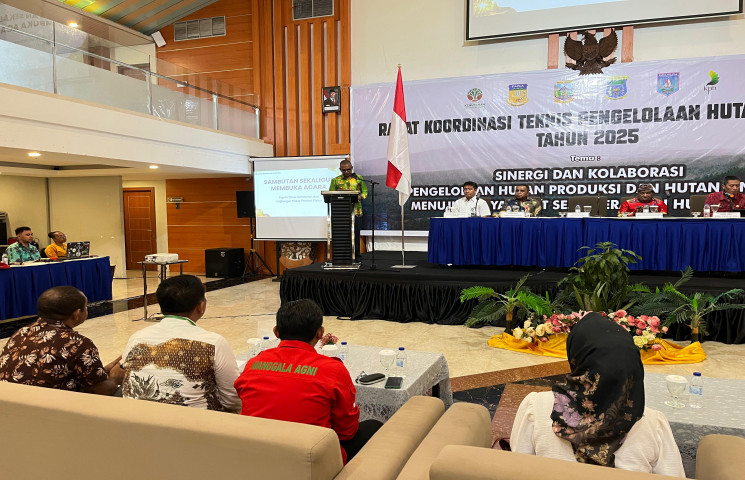
This was conveyed by the Acting Head of Provincial Forestry and Environment Office of Papua, Aries Toteles Ap, during the 2025 Technical Coordination Meeting on Sustainable Forest Management in Jayapura.
Aries explained that sustainable forest management rests on three core principles. First, ecological sustainability, which concerns maintaining the forest’s function as a life support system. Second, the principle of social justice, which involves recognizing the rights of indigenous and local communities. Third, sustainable economic benefits, which emphasize adding value to every forest product utilization, so that it brings a long-term impact.
“Papua is not only rich in forests, but also in local wisdom that has preserved the forests for generations,” he said during the meeting.
Therefore, sustainable forest management in Papua cannot rely solely on technocratic approaches. It must also respect and integrate traditional values and local culture.
Aries emphasized the importance of indigenous and local community involvement in forest management.
“We must involve them not just as objects, but as key subjects in every forestry policy and program. For the people of Papua, forests are not merely natural resources — they are part of their identity and spiritual life,” he stated.
Through this coordination meeting, it is hoped that it will produce technical policy formulations, action plans, and stronger collaborative mechanisms, so that forest management in Papua becomes not only sustainable on paper but also has a real impact on nature and the communities.
“It is important to realize that forest management is not only ecologically sustainable but also provides social and economic benefits for the people of Papua,” he concluded. ***


