29Aug 25
- Admin Web Papua
- ASN
- 3617 x dilihat.

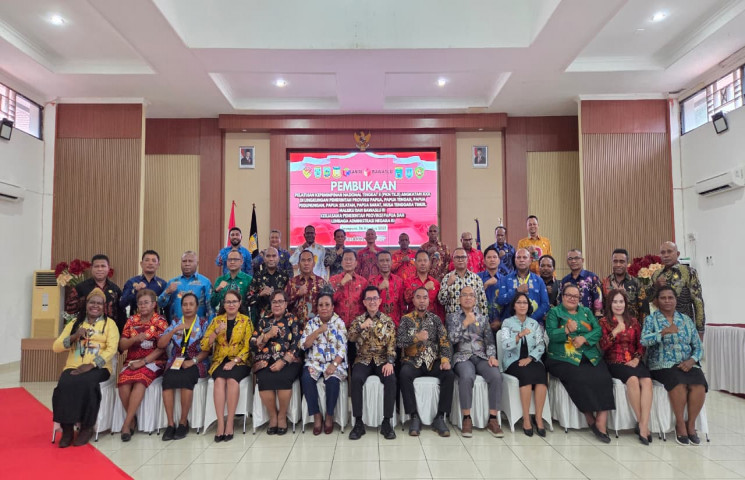
JAYAPURA – The Papua Provincial Government held the 30th Class of the National Leadership Training Level II for officials from the Papua Provincial Government, Central Papua, Highland Papua, South Papua, West Papua, East Nusa Tenggara (NTT), Maluku, and the General Elections Supervisory Agency, in collaboration with the Papua Provincial Government and the National Institute of Public Administration, on Tuesday (Aug. 26).
Acting Governor of Papua, Agus Fatoni, through the Acting Assistant for General Administration of the Papua Provincial Secretariat, Triwarno, stated that this was the third time Papua Province, through the Human Resource Development Agency, had independently organized National Leadership Training Level II, following accreditation in 2023.
“This training should not merely be seen as a requirement for holding a position, but rather as an opportunity to enhance capacity and improve competence in each individual’s area of duty,” Triwarno said.
He also emphasized that challenges in governance will become increasingly complex in the future, requiring senior officials to be well-prepared and equipped with more effective strategies and policies. This is essential to avoid being left behind amid rapid modernization and to meet public demands.
“I look forward to seeing concrete results in the form of innovations and breakthroughs that will be incorporated into the change projects you create, aimed at improving public services in Papua,” he added.
Meanwhile, the Head of the National Institute of Public Administration, Muhammad Taufiq, stated that strategic leadership in Papua is not only about managing organizations, but also about developing a sustainable long-term vision and fostering cross-sector collaboration to drive innovation in public services.
He further noted that development in Papua has unique characteristics, with specific challenges and opportunities. The geographical conditions, cultural diversity, and social dynamics of Papuan society require a leadership approach that is adaptive and sensitive to local contexts.
“Therefore, when entrusted with responsibilities as senior officials, that is the moment to serve as the front line of national development,” he concluded. ***


