02Sep 25
- Admin Web Papua
- Inflasi
- 2230 x dilihat.

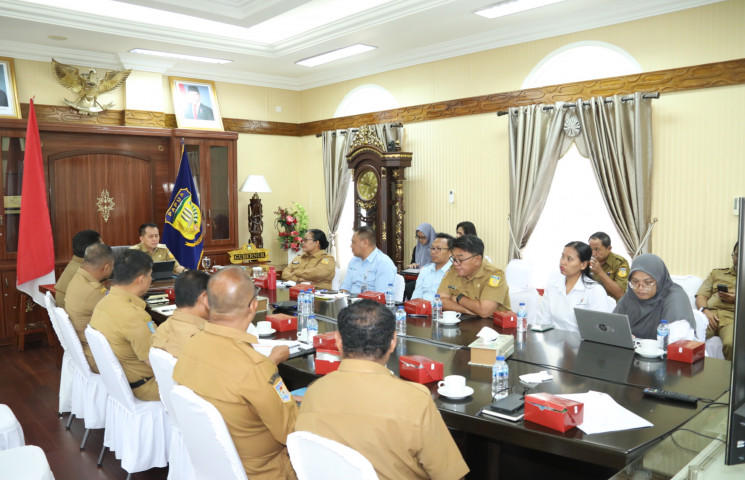
JAYAPURA – Acting Governor of Papua, Agus Fatoni, confirmed that inflation in the province remains under control. He made the statement after attending a Regional Inflation Control Coordination Meeting led by Minister of Home Affairs Muhammad Tito Karnavian via Zoom at Gedung Negara, Jayapura, on Tuesday (Sept. 2, 2025).
“We are grateful that inflation in Papua is relatively low, with a year-on-year rate of 0.4 percent and a month-to-month decline of 0.93 percent, which indicates deflation. This is a positive development, and we will continue working together to maintain stability,” Fatoni said.
As part of inflation-control measures, the Papua Provincial Government, in collaboration with regency and municipal governments, has carried out the Cheap Food Movement simultaneously across 18 districts. The initiative is part of a nationwide program implemented throughout Indonesia.
“We launched the Cheap Food Movement in Papua and will continue to conduct it regularly. The program is implemented nationwide, not only in Papua,” Fatoni explained.
Fatoni and his team also conducted direct inspections at Indonesian Bureau of Logistics warehouses, private warehouses, and retail markets. Monitoring results showed that rice stocks in Papua are sufficient for the next four months, while prices remain stable without significant increases.
“We visited Bureau of Logistics facilities, private warehouses, and retail markets, and found that rice stocks are secure for the next four months. Prices also remain stable; there has been no significant increase,” he noted.
According to Fatoni, maintaining sufficient stock is key to preventing price fluctuations. “We are grateful that supplies remain adequate, allowing rice to be sold at previous prices. If this stock is maintained, prices should remain under control,” he added.
Data from the Central Statistics Agency of Papua Province shows the region experienced deflation in August, driven by declines in air transportation fares, tuna, tomatoes, bumat fish, and several fruits. However, certain commodities continued to drive inflation, including rice, sea transportation, shallots, betel leaves, and chili.
The provincial government is also implementing broader measures to curb inflation. These include ensuring the availability of staple goods in markets, organizing regular low-cost markets and food programs, and providing transportation subsidies to cut distribution costs.
In addition, inter-regional cooperation is being strengthened to secure the supply of basic goods. The government is also encouraging local food cultivation—particularly chili—through community gardens and household yards, while providing farmers with seeds, fertilizers, and other production inputs.
“With adequate supplies, stable prices, and consistent control efforts, we are optimistic that Papua’s inflation will remain under control,” Fatoni concluded. ***


