19Sep 25
- Admin Web Papua
- Keuangan Daerah
- 3556 x dilihat.

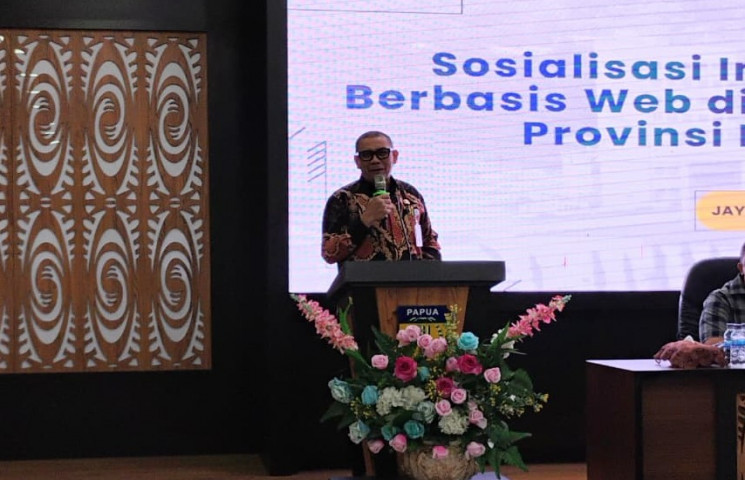
JAYAPURA – The Regional Financial and Asset Management Agency (BPKAD) of Papua Province introduced the Web-Based Payroll Information System (SIM Gaji) to improve the management of employee salaries and allowances within the Papua Provincial Government. The socialization event was officially opened by Acting Head of the Regional Financial and Asset Management Agency of Papua Province, Rusdianto Abu, at the Hall of the Papua Provincial Communication and Informatics Office on Thursday, September 19, 2025.
In his remarks, Rusdianto explained that the rapid development of information technology requires local governments to continuously innovate in financial management. Payroll processes, which have been carried out manually or through limited desktop-based applications, often face obstacles related to speed, accuracy, and data security.
“The Papua Provincial Government, through the Regional Financial and Asset Management Agency in collaboration with PT Taspen Jayapura Branch, has introduced this Web-Based Payroll Information System. We expect this system to answer the challenges we have been facing,” said Rusdianto.
He further emphasized that the adoption of SIM Gaji is expected to bring significant improvements in payroll administration. These include greater efficiency, more accurate data processing, improved transparency and accountability, and stronger monitoring and evaluation mechanisms.
Rusdianto also underlined the crucial role of expenditure treasurers and payroll officers as the frontliners of financial administration. According to him, the system will only be successful with the active commitment, cooperation, and discipline of all parties involved.
“The implementation of this system will not succeed without the commitment and cooperation of all stakeholders,” he stressed.
He then invited all participants to view the roll-out of the Web-Based Payroll Information System not merely as a technical adjustment, but as a momentum for change in regional financial management. The system, he said, should be a stepping stone toward more modern, efficient, and integrity-based governance, ultimately leading to improved public services for the people of Papua. ***


