28Sep 25
- Admin Web Papua
- Internet
- 4135 x dilihat.

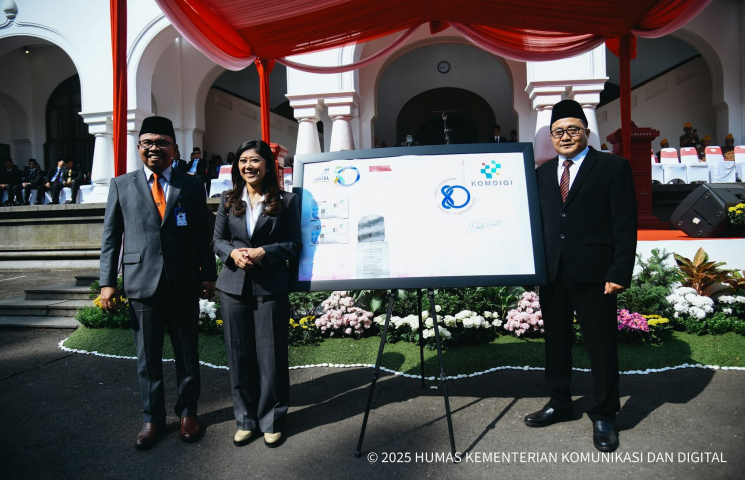
JAKARTA – Postal and telecommunications services are not merely technical matters. From delivering packages to remote villages to bringing internet access to rural communities, this sector has become an inseparable part of Indonesians’ daily lives.
Minister of Communication and Digital Affairs, Meutya Hafid, emphasized this point when she served as inspector of the ceremony commemorating the 80th Postal and Telecommunications Service Day at the Head Office of PT Pos Indonesia (Persero) on Saturday (September 27, 2025).
“Every package delivered carries data, hope, and messages, while also reflecting society’s consumption patterns. This must bring benefit to the nation. If this sector is not sovereign, such data could become a strategic vulnerability exploited by external parties,” said Meutya.
She stressed that postal services are not only about delivering goods but also about connecting people’s lives: from migrant workers sending remittances, small traders selling online, to students in remote areas in need of textbooks.
Meutya also expressed her appreciation to all stakeholders in the postal sector, which enabled Indonesia to be elected as a member of the Council of Administration (CA) and the Postal Operations Council (POC) for the 2025–2029 term at the 28th Universal Postal Union (UPU) Congress.
“This opportunity must be maximized for us to play an active role in the global postal ecosystem, help shape the future of international postal services, and at the same time strengthen Indonesia’s domestic postal industry,” she stated.
On this occasion, Meutya also underlined the importance of telecommunications. She acknowledged that there are still 2,333 villages without internet access, 2,017 villages without 4G service, and 316 villages consisting of non-residential farmland that remain completely unconnected.
“Today, the struggle is not over. Let us continue the fight once carried out by the Young Generation of Post, Telegraph, and Telephone (AMPTT) in 1945,” she stressed.
According to her, every tower, fiber optic cable, and signal reaching villages is not just infrastructure but also a bridge enabling people to learn, trade, work, and voice their opinions more easily.
“Every tower built, every fiber optic cable stretched, and every village connected to the internet is a tangible foundation toward achieving the target of 8 percent economic growth,” she said.
She added that robust telecommunications infrastructure not only supports national defense but also ensures that young people in villages have equal opportunities as those in urban areas.
Quoting the theme of the 80th Postal and Telecommunications Service Day, Collaboration Accelerates Digitalization, Meutya invited all stakeholders to support the national digitalization agenda.
“Postal Service Day will always remind us that the future is shaped by our own hands. The postal service will remain the heart of logistics for the people, telecommunications will continue to be the nation’s digital lifeline, and together they will form the strong foundation of Indonesia’s sovereignty,” she concluded.
Also attending the event were Deputy Minister of Communication and Digital Affairs Nezar Patria, Acting President Director of PT Pos Indonesia (Persero) Haris, representatives from broadcasting institutions, telecommunications operators, technology companies, the media, industry associations, and representatives of the Postel Veterans Corps/Indonesian Veterans Legion (KVK Postel/LVRI). ***


