23Oct 25
- Admin Web Papua
- Kehutanan
- 3685 x dilihat.

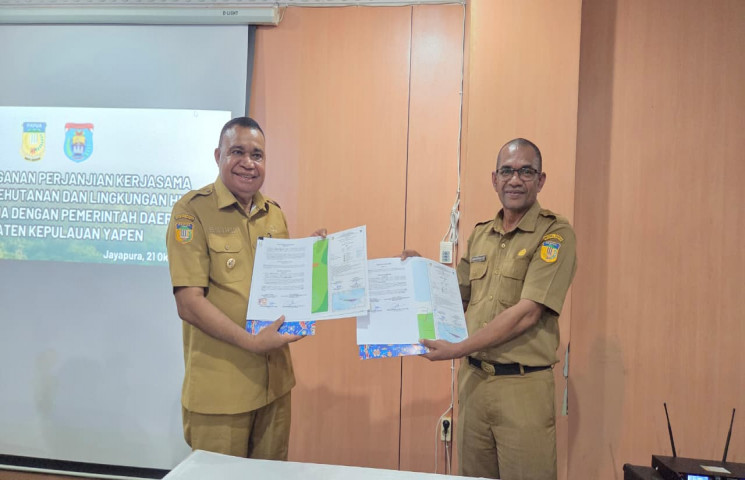
JAYAPURA – The Yapen Regency Government and the Papua Provincial Forestry and Environment Agency (DKLH) have established a partnership to utilize forest areas for the development of Micro-Hydro Power Plants (PLTMH).
Two cooperation agreements were signed, covering the use of forest areas for the construction of PLTMH facilities in Ausem Village, Pulau Yerui District, and Soromasen Village, North Yapen District, Yapen Islands Regency.
Yapen Islands Regent, Benyamin Arisoy, stated that the collaboration is crucial to ensure the protection and preservation of local forest ecosystems, as the project sites are located within protected forest zones.
“Through this cooperation, the designated areas must be preserved — both by the surrounding communities and by ensuring that no activities harm the environment,” said the Regent.
He emphasized that the agreement seeks to guarantee that the utilization of forest areas remains sustainable and environmentally responsible.
“Since this is a protected forest area, a proper permit is required for its use. Therefore, before any activity takes place, an agreement must be made so that the regional government, as the second party utilizing the area, bears the obligation to protect it together with the community,” he explained.
The Regent also expressed hope that the initiative would bring tangible benefits to residents, as electricity is a basic necessity that supports both community welfare and economic growth.
Meanwhile, the Acting Head of the Papua Provincial Forestry and Environment Agency, Aries Toteles Ap, said that as a technical institution, DKLH is responsible for serving all Indonesian citizens, including those in remote areas of Papua.
“We fully support the Regent of Yapen and our colleagues in the Yapen Islands who are working to bring electricity to villages that still lack access to power,” he said.
The cooperation aims to facilitate forest utilization for renewable energy development by identifying potential natural resources suitable for electricity generation. The initiative is expected to provide lighting access for rural communities, particularly in areas not yet reached by conventional power grids.
“This collaboration is expected to deliver concrete solutions for residents of the two villages, granting them better access to electricity and improved living conditions,” he concluded. ***


