21Feb 26
- Admin Web Papua
- Pembangunan Daerah
- 1771 x dilihat.

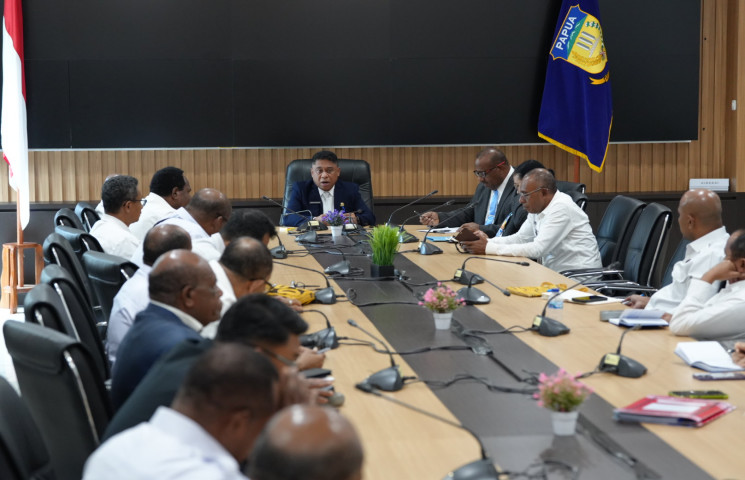
JAYAPURA — The Papua Provincial Government is strengthening coordination across regional agencies in infrastructure development planning. This effort is aimed at ensuring that development programs run in an integrated manner and avoid overlap between different levels of government.
The enhanced coordination was discussed in the Regional Agency Forum on Program Synchronization and Infrastructure Data Planning, which involved five regional agencies in the infrastructure sector: The Public Works Office, Transportation Office, Housing Office, Communication and Information Office, and Energy and Mineral Resources Office.
Acting Papua Regional Secretary Christian Sohilait said the forum serves as a platform to align perspectives between the central government, provincial government, and district/city administrations. Synchronization is necessary because many infrastructure activities are carried out by central government technical units, the provincial government, as well as local governments.
"We need to sit together so that the division of roles is clear — which projects are handled by the central government units, which by the province, and which by the districts or cities," Christian said in Jayapura.
He explained that the results of the forum would become material for further discussions with ministries and institutions at the central level. Programs that have been agreed upon will then be proposed for inclusion in national planning documents to secure budget support.
In addition to preventing project duplication, the synchronization effort is also intended to strengthen regional connectivity. Christian stressed that infrastructure development must be interconnected so that it can truly help open up isolated areas.
"If one region builds a road from one direction, development from the other direction must be connected to it. Infrastructure should not stand alone without links," he said.
According to Christian, integrated planning will ensure that infrastructure development supports transportation access, the distribution of goods, and the improvement of public services. The forum also provides an opportunity for newly elected regional heads to present their development priorities in their respective areas. ***


