12May 26
- Admin Web Papua
- Pembangunan Daerah
- 867 x dilihat.

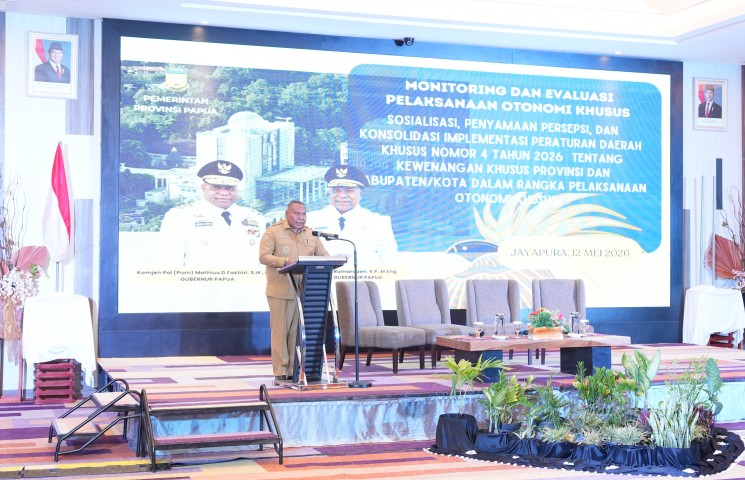
JAYAPURA – Papua Deputy Governor Aryoko Rumaropen officially opened the Monitoring and Evaluation of Special Autonomy Implementation, as well as the Socialization, Alignment of Perceptions, and Consolidation of the Implementation of Special Regional Regulation Number 4 of 2026 concerning the Special Authorities of the Province and Regencies/Municipalities in the implementation of Papua's Special Autonomy. The event was held at a hotel in Jayapura City on Tuesday (May 12).
The activity was attended by regional leaders from regencies and municipalities across Papua, heads of Papua Provincial Government offices, and several related technical agencies as part of efforts to strengthen the synergy of integrated Special Autonomy implementation, oriented toward the protection and empowerment of Indigenous Papuans.
In his remarks, Papua Deputy Governor Aryoko A.F. Rumaropen emphasized that the implementation of Special Autonomy must be carried out collaboratively and measurably to address the real needs of the Papuan people. According to him, Perdasus Number 4 of 2026 serves as an important foundation for clarifying the special authorities of regional governments and strengthening development synchronization between the provincial government and regency/municipal governments.
"Through this consolidation, we want to ensure that all stakeholders have the same perception in implementing Special Autonomy, so that the vision of a Bright Papua can be realized concretely and sustainably," Aryoko said.
The event featured three main speakers who presented various strategic aspects of the implementation of Papua's Special Autonomy.
A representative of the Papua Provincial Regional Development Planning, Research, and Innovation Agency, represented by the Head of the Social and Cultural Affairs Division, Makmur, outlined the macro achievements of regional development, the vision and mission of the Papua Provincial Government in the 2025–2029 Regional Medium-Term Development Plan, and the integration of the Special Autonomy development planning cycle into regional development priority programs.
Meanwhile, Agency for the Acceleration of Papua Special Autonomy Implementation of Papua, through the Head of the Economic Working Group, emphasized the strategic role of Agency for the Acceleration of Papua Special Autonomy Implementation as a special institution established to oversee the implementation of Special Autonomy through the functions of synchronization, harmonization, evaluation, and coordination among stakeholders.
In addition, an academic for Democracy Studies of Cenderawasih University, Dr. Lily Bauw, explained the philosophical meaning of Special Regional Regulation Number 4 of 2026, which specifically regulates the health, education, and people's economy sectors for Indigenous Papuans. According to her, the regulation serves as a strategic legal umbrella for elaborating priority programs that sustainably favor Indigenous Papuans.
The activity also served as a forum for aligning perceptions among regional governments in strengthening the implementation of special authorities, while building a shared commitment to support the realization of a Papua that is intelligent, healthy, productive, prosperous, and harmonious through effective and well-targeted implementation of Special Autonomy. ***


