13Jun 25
- Admin Web Papua
- Kependudukan
- 4935 x dilihat.

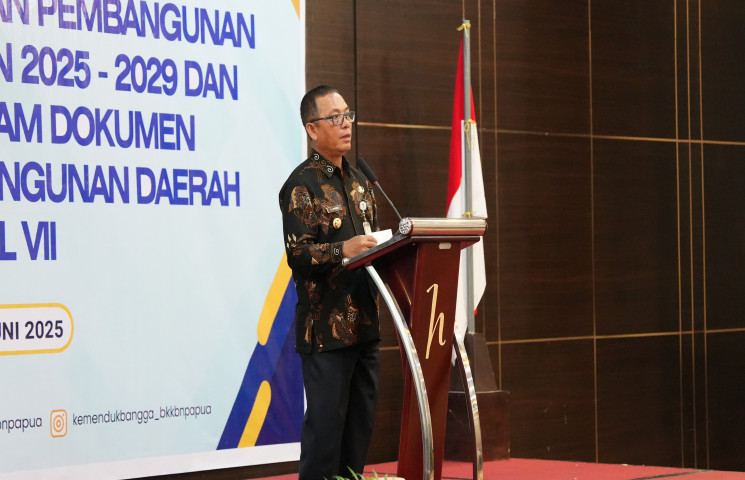
JAYAPURA – Acting Governor of Papua, Ramses Limbong, emphasized that population development is not the responsibility of a single institution. According to him, all stakeholders must be actively and coordinately involved.
This statement was delivered after he officially opened the Internalization of the 2025–2029 Population Development Roadmap and Action Plan in the Regional VII Development Planning Document in Jayapura on Friday (June 13, 2025).
“Population issues do not belong to just one organization or ministry. They are the shared responsibility of everyone, from the national to the local level,” he said.
He cited stunting as an example — a challenge that requires cross-sectoral intervention. The effects of stunting in children aged 0–5 years can persist for 20 to 30 years.
“If we don’t address it now, stunting will become a long-term burden. We want these children to grow into productive individuals, and that means all sectors must take action,” he stressed.
Ramses also noted that addressing family planning (FP) challenges in Papua requires cultural sensitivity so as not to conflict with local traditional values.
“Here, many believe that having many children is a blessing. But if income is limited and nutrition isn’t met, it can lead to stunting and other diseases. We need a win-win solution,” he explained.
He expressed hope that coordination between the National Population and Family Planning Agency (BKKBN), provincial and district/city governments, and other institutions would continue to be strengthened. The goal is to shape healthy, intelligent, and competitive human resources in Papua.
“If we all commit, we can do it. We don't want Papua to lag behind other regions. We want to have measurable benchmarks — for instance, a 4% reduction in stunting — and we must ensure that progress is evident on the ground,” Ramses concluded. ***


