24Jan 26
- Admin Web Papua
- Pembangunan Daerah
- 3999 x dilihat.
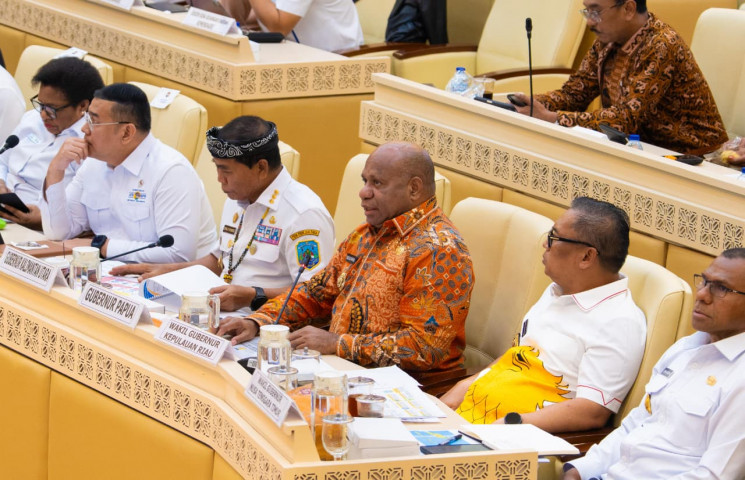
JAKARTA — Papua Governor Matius D. Fakhiri outlined the policy direction and strategic development programs for border areas during a Working Meeting and Hearing of the State Border Working Committee of Commission II of the House of Representatives. The meeting was held in the Commission II meeting room of the House of Representatives on Wednesday (21/1).
The forum discussed strategic issues and border development programs in each region. The meeting was also attended by the Governor of North Kalimantan, the Deputy Governor of the Riau Islands, the Deputy Governor of East Nusa Tenggara, and the Deputy Minister of Home Affairs.
In his presentation, Governor Fakhiri stressed that Papua's border development should no longer be viewed as concerning an outermost and underdeveloped region. Border areas must become the nation's strategic front porch for sovereignty, the economy, and public welfare.
"Development in border areas must shift from an inward-looking pattern to an outward-looking one, so that border regions can grow as nodes of economic growth, centers of cross-border interaction, and symbols of the state's presence," the Governor emphasized.
The Governor explained that the Papua Provincial Government has implemented some programs for coordination, integration, and synchronization of border area development. These include housing development for former cross-border residents (repatriates), preparation of the Detailed Spatial Plan for Keerom Regency, and coordination meetings on border area infrastructure development.
The government is also conducting studies on the development potential of border regions, including plans to build a border market. This step is intended to strengthen the economic activities of border communities.
In the area of border demarcation and security, the government has carried out public outreach on land and sea cross-border regulations. Activities have also included joint verification of border crossers and maintenance of border markers between Indonesia and Papua New Guinea.
In the field of cross-border cooperation, Papua has actively promoted regular agendas such as the Indonesia–Papua New Guinea Border Trade Fair/Festival, Border Liaison Meetings, and Indonesia–Papua New Guinea Border Liaison Officer Meetings. These activities are conducted as annual forums for coordination and border cooperation.
At the meeting, the Governor of Papua also presented a proposal to build a State Border Crossing Post in Waris District. In addition, he proposed the construction of a State Sea Border Crossing Post in Jayapura City.
The Governor said this infrastructure is important to strengthen cross-border services as well as supervision of land and maritime border areas. The proposal is intended to reinforce the state's function in border regions.
The Governor also highlighted some strategic issues in Papua's border areas, including defence and security vulnerabilities, regional isolation and underdevelopment, and issues concerning customary land rights and state boundaries.
Other issues of concern include the still-suboptimal management of natural resources, the low quality and quantity of human resources, and illegal cross-border activities. The government believes these issues must be addressed through integrated cross-sector policies.
As part of its future policy direction, the Papua Provincial Government is pushing to improve regional connectivity and accessibility. The government is also preparing to strengthen basic infrastructure such as housing, electricity, clean water, and telecommunications.
Other policies include strengthening the economy based on local potential and tourism, improving the quality of human resources and basic social services, and reinforcing security and national identity. The provincial government also emphasized the need for cross-sector and cross-border cooperation.
In closing his presentation, Governor Fakhiri asked for the support of Commission II of the House of Representatives so that development in Papua's border areas can proceed in a more integrated and sustainable manner. The government hopes the benefits of these programs will truly be felt by border communities.
"We hope for the full support of Commission II of the House of Representatives so that development in Papua's border areas can move forward in a more integrated, sustainable way and truly be felt by border communities," the Governor concluded. ***


