20Mar 26
- Admin Web Papua
- Bencana Daerah
- 1332 x dilihat.
JAYAPURA — The Papua Provincial Government has urged all Papuans to heighten their vigilance following weather conditions in recent days that have shown increasingly severe and unfavourable patterns.
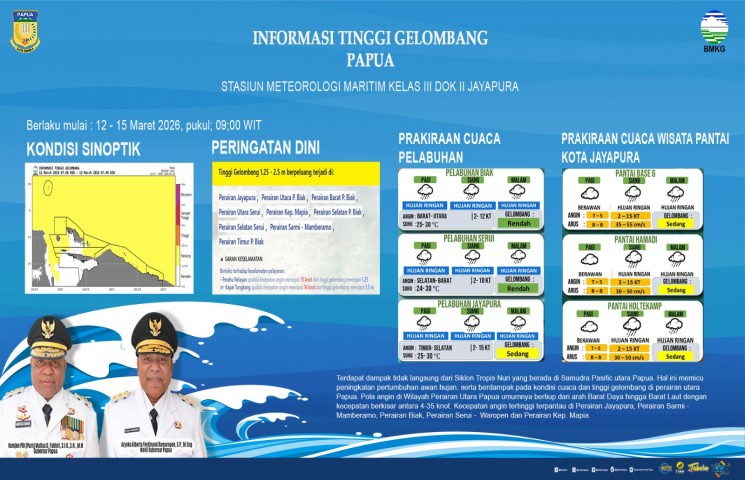
According to official information from the Meteorology, Climatology, and Geophysics Agency, there has been increased atmospheric activity in the form of wind convergence over Papua, which has affected the growth of rain clouds, increased wind speeds, and caused significant sea wave heights in several waters.
"This is not an ordinary weather situation. We are facing natural dynamics that must be met with full vigilance, not carelessness."
Sea waves in several Papuan waters have reportedly reached moderate to high levels, with the potential to rise to 2.5 to 4 meters, especially in the waters of Jayapura, Sarmi, Mamberamo, Biak, Serui, and Waropen. These conditions pose a high risk to shipping activities, particularly for traditional fishermen and small-scale sea transportation.
The Papua Provincial Government specifically issued several important appeals:
"The safety of the public is the top priority. No economic activity is more important than human life. Therefore, we ask all people not to force themselves to carry out activities amid extreme weather conditions."
The Papua Provincial Government is also continuing to coordinate with the Meteorology, Climatology, and Geophysics Agency, National Search and Rescue Agency, the military and police, and all stakeholders to ensure preparedness for the worst possible scenarios.
Therefore, in a situation like this, what is needed is collective awareness.
"Nature is giving a warning. Our task is to read it, understand it, and respond wisely. Do not wait for disaster to strike before we act."
In closing, the public is urged to continue monitoring official information from the government and not to easily believe unverified information.
Papua must remain strong, but it must also be wise in facing risks. ***


