27Aug 26
- Admin Web Papua
- OAP
- 554 x dilihat.
JAYAPURA – The Papua Provincial Government is strengthening mechanisms for resolving customary land rights to provide certainty for Indigenous communities and the government. Settlements are carried out through customary agreements reinforced by legal and administrative documentation.
Papua Governor Matius D. Fakhiri said every customary land issue needs to be fully resolved before compensation is paid. This measure is necessary to prevent the same land from becoming the subject of claims again in the future.
Fakhiri said initial discussions must be conducted through the customary deliberation forum, involving Ondoafi, tribal chiefs, customary land rights holders, families, and other relevant parties. Agreement among all parties serves as the basis for resolving customary land rights.
“Development must continue, and the rights of Indigenous communities must be respected,” Fakhiri said. “Every land issue must be resolved once and, of course, properly, fairly, and thoroughly.”
According to him, customary agreements need to be documented clearly. The documents should include the boundaries and size of the land, ownership history, and the genealogy of the rights holders.
The documentation should also include a statement of release of rights, minutes of the agreement, and proof of payment. All of these documents are essential to ensure that the settlement process has a clear administrative basis.
Fakhiri requested that the settlement documents subsequently be verified and coordinated with the Papua Provincial Government's asset management team. This process is necessary to ensure that land administration is properly organized.
He does not want payments that have already been made to be followed by new claims several years later. Such claims could come from children, grandchildren, great-grandchildren, or other groups claiming rights to the same land.
Therefore, Fakhiri called on all families and parties with customary rights to be aware of and approve decisions reached through the customary deliberation forum. Once the customary and administrative processes have been completed, he will meet directly with representatives of the Indigenous communities.
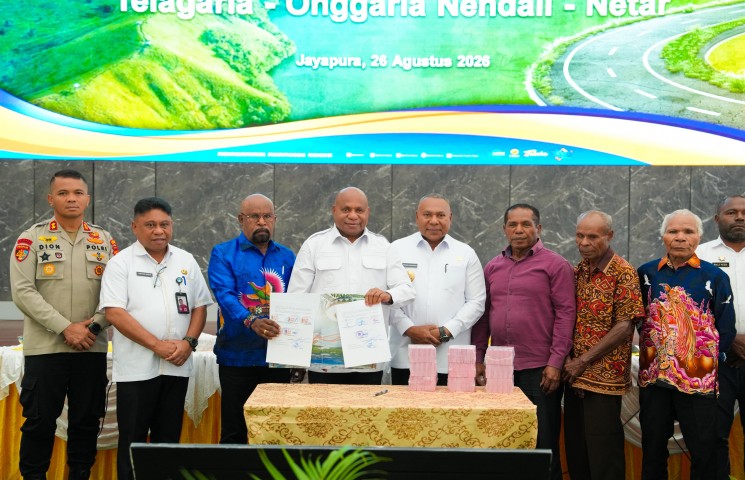
This commitment was demonstrated through the initial payment of compensation for customary land rights related to the development of the Telagaria–Onggaria–Nendali–
Fakhiri said the settlement of customary land rights must provide certainty for Indigenous communities while allowing development to continue. According to him, land in Papua carries a history and intergenerational connections that must be respected in every development process. ***


